
Why You Need to Know Your Axle Model
When you call us for parts, one of the first things we ask is: "What axle do you have?" Not what truck — what axle.. Year, make, and model get you in the neighborhood, but they don't get you the right parts. The same truck can have completely different axles depending on the options it was ordered with. A 1978 Ford F-250 could have a Dana 44 or a Dana 60 up front — and those two axles share almost nothing..
So before you order bearings, seals, gears, or a rebuild kit, identify what you're working on. That's what this guide is for.
The BOM Tag — Your Best Friend
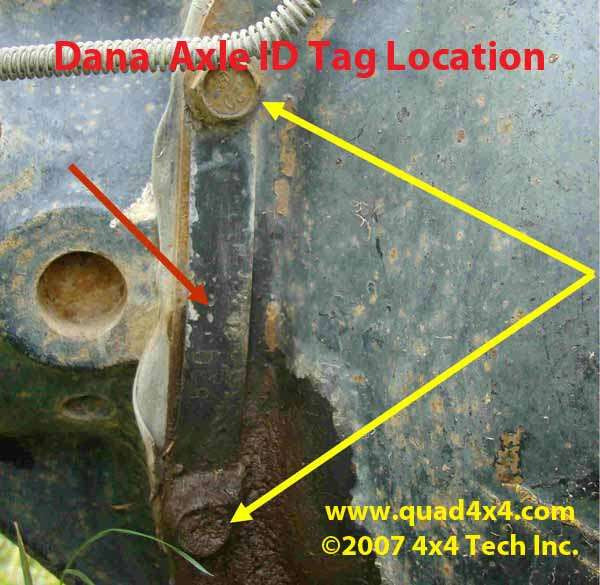
Starting around 1965, Dana began stamping metal tags and affixing them to the differential cover with two of the cover bolts. Each tag has a Bill of Material (BOM) number on it — a 6-digit number starting with 6, followed by a dash number (example: 610604-2). The dash number indicates the axle ratio.

The BOM number identifies not just the axle model, but the exact components the axle was built with at the factory. Different BOM numbers mean an engineering change — could be minor, could mean different bearings or a different seal. When we ask for your BOM number, we're making sure we send you the exact right parts.

Around mid-2004, Dana switched to 7-digit BOM numbers starting with 2. Same purpose, same location.
Problem: These tags are often missing. If the differential cover has ever been pulled for service, the tag may have been left off when the cover went back on. That's where the other identification methods come in.
Where Else to Find the BOM Number
Many axles have the BOM number stamped directly on the axle tube in addition to the tag. On front axles, check the front face of the left or right axle tube. On rear axles, look at the back of the right axle tube. The stamping can be faint and covered in grime — hit it with a wire brush before you give up looking.

Some axles — particularly 1990+ Ford units — also have a white data decal on the right axle beam. If it's still readable, it'll have the Dana BOM number, the Ford axle code, the serial number, the Ford assembly part number, and the date the axle was built. These decals are designed to last, but most of them eventually become illegible or fall off.
In addition to the BOM tag, many axles have a separate ratio tag secured by a single diff cover bolt. If the axle has a limited-slip differential, the ratio tag will also have the letter "L" (example: 3.73L).

Identify by Differential Cover
If the tag is gone and the tube stamp is unreadable, the differential cover shape and bolt count will narrow it down fast.
Dana 44
10-bolt cover, approximately 10⅜" high × 9⅜" wide. Bolt head size is ½", thread is 5/16 USS coarse. Early covers (up through mid-1970s) are thin stamped steel with embossed reinforcing ridges and require a gasket. Later covers are stamped from heavier gauge steel and can be sealed with either a gasket or RTV.

Dana 60
10-bolt cover, approximately 12" high. Ring gear is 9⅞" with 12 ring gear bolts. The cover looks similar to a Dana 70 — telling them apart from the outside is covered below.

Dana 70
10-bolt cover — visually almost identical to a Dana 60. The covers share the same bolt pattern. One reliable way to tell them apart: measure the cover flange height. The Dana 60 flange is approximately 1" high. The Dana 70 flange is about 1¼" high. If you can't measure the flange, pull the cover and measure the ring gear. Dana 60 ring gears are 9⅞". Dana 70 ring gears are 10½".

Dana 80
1110-bolt cover, but significantly taller than the 60 or 70 — approximately 13½" high × 11" wide. Bolt pattern is 12½" high × 10¼" wide. Dana 80 rear axles have been in production since 1988 and were used in Chevy/GMC (1992–2002), Dodge (1994–2002), and Ford (1988–current) trucks, vans, and motorhome chassis..

GM 10 Bolt
Oval cover with 10 bolts, 11" high × 10¼" wide. Unlike the Dana 44 cover, the GM 10 Bolt cover does not have any flat sides — it's a smooth oval. Found on Chevy and GMC ½-ton and ¾-ton 4x4 pickups from 1977–1987, and Blazer/Jimmy/Suburban from 1977–1991.

AAM 9.25" (925)
14-bolt cover. Found on most 2003–2013 Ram 2500 and 3500 4x4s. Also called the AAM 925 or AA 9¼". Iron beam front axle with a 9¼" hypoid gear set. Ring gear attached with 12 left-hand thread bolts. If you're not used to left-hand thread ring gear bolts, now you know.

Closed Knuckle vs. Open Knuckle
If you're working on a truck built before the mid-1970s, you may have a closed knuckle front axle. Understanding the difference matters because the parts are completely different.
On a closed knuckle axle, the steering knuckle is sealed around a ball welded to the end of the axle tube. The axle U-joint is totally enclosed — you can't see it without disassembly. Everything inside is bathed in lubricant. In theory, this means longer part life. In practice, the seals leak, the lube gets contaminated, and nobody services them until something breaks.
Open knuckle axles use ball joints or king pins with their own seals, and the U-joint is exposed and visible.
Closed knuckle axles only turn about 28–30 degrees. Open knuckle axles can handle 40–42 degrees. That's a dramatically different turning radius.


When domestic 4x4s switched from closed to open knuckle:
- 1966 — Ford F100, Bronco
- 1969 — Chevy Blazer
- 1970 — All other Chevy and GMC 4x4 models
- 1971 — IHC Scout
- 11972 — Dodge W100, W200; IHC ½-ton and ¾-ton trucks; Jeep CJ and Commandoo
- 1974 — Jeep Wagoneer and Truck
- 1975 — Dodge W300
- 1976 — Ford F250
If your truck predates this list, you have a closed knuckle axle. The knuckle ball diameter tells you the axle model: 5" ball = Dana 25, 27, 30, or standard-duty 44. 7" ball = Dana 44HD, 60, or 70.

Make-Specific Notes
Dodge / Ram
Dodge used Dana 44 front axles (closed knuckle) from 1957–1971 in W100 and W200 trucks, and Dana 70 front axles (closed knuckle) from 1958–1974 in W300s and some specially equipped W200s. The open knuckle Dana 60 with disc brakes replaced the closed knuckle Dana 70 for 1975.
For 1994–2002 Rams, every Dana rear axle has a BOM tag on the diff cover. The 1994–1997 and 1998–1999 Dana 60 front axles have different ABS configurations — 1994–1997 uses an external sensor on the steering knuckle reading an outer axle shaft tone ring, while 1998–1999 moved to an internal sensor reading a tone ring inside the hub assembly. Same axle model, different parts.

2003+ Rams with the AAM 925 front axle: the engine option determines your bearing kit. HO (High Output) Cummins trucks get different components than the non-HO. This is one of the most common ordering mistakes we see.
Coil spring suspension note: All 1994+ Ram 2500/3500 4x4 trucks with solid beam front axles use a 5-link coil spring front suspension — 4 link arms behind the axle plus a track bar in front. If your truck has this setup, you have a 1994+ Ram with either a Dana 60 or AAM 925 front axle.

Ford
Ford offers more front axle variety than any other make in this era. A ¾-ton F-250 could have a Dana 44 or a Dana 50 or a Dana 60, depending on year and options.
Quick hub test: If your axle has an internally splined hub, measure the diameter at the outboard end of the wheel hub (not the lockout hub). Standard-duty ¾-ton hubs (Dana 44) are about 3⅝". Heavy-duty hubs (Dana 50IFS, Dana 60) are about 4³⁄₁₆".


Ford Dana 50IFS / Dana 44IFS (Twin Traction Beam): 1980–1997 F-250s and 1980–1996 Bronco/F-150s used independent front suspension with Dana 44 or Dana 50 axles. These TTB (Twin Traction Beam) axles have unique hubs, knuckles, and beam pivot bearings that are not interchangeable with solid-beam axles of the same model. The 50IFS and 44IFS are application-specific — make sure you're ordering for the IFS variant if that's what you have.
Ford monobeam front axles (1985+): These have a BOM tag on the diff cover plus (on 1990+ axles) a white data decal on the right beam. The BOM format is the standard 6+dash or 7+dash number.

GM / Chevy / GMC
GM used the 10 Bolt front axle in ½-ton and ¾-ton 4x4s from 1977–1991 and the Dana 60 in 1-ton 4x4s from 1977–1991. GM did not offer a factory Dana 60 option in ¾-ton trucks — but a lot of Dana 60 swaps from 1-ton trucks have ended up in ¾-tons over the years. If you've got what you think is a Dana 60 in a Chevy ¾-ton, someone put it there.
1984–1991 GM Dana 60 axles should have a BOM tag on the diff cover. 1977–1983 axles usually have the BOM stamped on the tube but may not have a tag.
Jeep
Jeep has used Dana-Spicer axles since 1941. Most axles built since the mid-1950s will have an axle code stamped on one of the tubes. The early codes include a Spicer assembly number and date code. By the mid-to-late 1960s, Dana started assigning the standard 6+1 digit BOM numbers and affixing metal tags to Jeep axle diff covers.


Jeep used Dana 25, 27, and 30 front axles in various models from 1941 through the 1980s, and Dana 44 axles in full-size Wagoneers, J-series trucks, and Cherokee Chief models. Knowing which Dana model your Jeep has is critical because the axle shaft splines, bearing sizes, and seal dimensions are all different between models.
International Harvester
IHC offered the Dana 70 closed knuckle front axle as a factory option starting in 1961 for C-Series models. You'll find Model 70 axles in both 1-ton Class 3 (FA52 axle code) and 2-ton Class 6 (FA54 axle code) vehicles. Other than the housings, axle shafts, wheel-end parts, and steering components, most internal parts are interchangeable across years and models.
Casting Numbers
Many Dana axles have the model number cast directly into the differential housing. This is the quickest visual check if the tag is missing and you can get a clear look at the housing. Clean off the dirt and look for raised or recessed numbers on the cast iron. Not all axles have them — but when they're there, it's a definitive ID.

Still Not Sure?
If the tag is gone, the tube stamp is worn off, and you can't make out a casting number, here's what to do:
- Measure the differential cover and count the bolts
- If front axle: check whether it's closed or open knuckle
- If you can pull the cover: measure the ring gear diameter and count the ring gear bolts
- Measure the stub shaft spline count and diameter
- Take photos of everything — the cover, the housing, any stamps or numbers you can find, and the overall axle from a few angles
Send us the photos and measurements. We identify axles every single day — it's one of the most common calls we get. Between the cover shape, ring gear size, spline count, and your vehicle info, we can nail it down.
Call (866) 251-6762 or email sales@torqueking.com.
Tech Pages by Make
We maintain detailed identification pages for specific axle models and year ranges. Each one includes photos of tag locations, specs, and the information you need to order the right parts:
- Chevy & GMC Front Axle ID
- Chevy & GMC Rear Axle ID
- Dodge & Ram Front Axle ID
- Dodge & Ram Rear Axle ID
- Ford Front Axle ID
- Ford Rear Axle ID
- IHC Front Axle ID
- IHC Rear Axle ID
- Jeep Front Axle ID
- Jeep Rear Axle ID


Leave a comment
This site is protected by hCaptcha and the hCaptcha Privacy Policy and Terms of Service apply.