Why U-Joint Identification Matters
U-joints are not interchangeable. A 1310 series u-joint will not fit a 1350 yoke, and installing a 1355 u-joint in a 1410 yoke — even though the cap diameter is identical — will give you a dangerously tight fit that shortens part life. The difference between some series is as small as 0.003" to 0.010", but that's enough to matter.
To order the right u-joint, you need to know the series. Here's how to identify what you have.
How to Measure a U-Joint
Two measurements identify the series:
- Cap diameter — the outside diameter of the bearing cap (the round part that sits in the yoke)
- Overall installed width — measured from the outside of one cap to the outside of the opposite cap when the u-joint is installed in the yoke
You also need to know how the u-joint is retained: external snap rings (fit in grooves in the yoke ears), internal C-clips (fit in grooves in the caps), U-bolts, or strap and bolts.
U-Joint Series Identification
Spicer 1310 Series
The 1310 has been in production since 1940 — it's the original light-truck driveshaft u-joint. Still found in some ½-ton and lighter applications today, though its use has been declining since the late 1970s.
Specs:
- Cap diameter: 1-1/16"
- Overall installed width: 3-7/32"
- Retention: External snap rings in driveshaft yokes; U-bolts or strap/bolts at end yokes

Spicer 1330 Series
FFFirst used in production cars in 1957, the 1330 didn't see light truck use until 1968 and wasn't common until Ford started replacing 1310s with 1330s in 1978. Ford was the primary user through the mid-1990s. Dodge used 1330 u-joints in 1994–2004 Ram front CV driveshafts and many 1998–2010 Ram 1500 rear shafts. Several GM and Jeep models from 2000–2010 also use 1330 series. Toyota and Nissan now use 1330 series in US-assembled trucks and SUVs...
Specs:
- Cap diameter: 1-1/16"
- Overall installed width: 3-5/8"
- Retention: External snap rings; U-bolts or strap/bolts at end yokes
Key difference from 1310: Same cap diameter (1-1/16"), but wider — 3-5/8" vs 3-7/32". If the caps are 1-1/16" and the installed width is over 3½", it's a 1330.

Spicer 1330F Series (Ford Only)
Only Ford used the 1330F — in 1962–1978 cars and 1979–1997 F-Series trucks, E-Series vans, and full-size Broncos. The "F" stands for the oversized caps on the end-yoke side. Ford's engineers increased two of the four cap diameters from 1-1/16" to 1-1/8" to prevent cap distortion when U-bolts are overtightened. It worked.
Specs:
- Cap diameter (driveshaft yoke): 1-1/16"
- Cap diameter (end yoke): 1-1/8"
- Overall installed width: 3-5/8"
- Retention: External snap rings in driveshaft yokes; always U-bolts at end yokes
How to tell 1330 from 1330F: Measure the U-bolt center-to-center width at the end yoke. 1330F = 1-37/64". Standard 1330 = 1-13/32".
Warning: On 1979–1997 Ford trucks, you may find both 1330 and 1330F u-joints on the same driveshaft. The 1-1/16" caps always go into the driveshaft yoke; the 1-1/8" caps always go into the end yoke. Get this backwards and you'll have a problem.

Spicer 1310 × 1330 Series (Ford Only)
Another Ford-only part. This is an unequal-width cross — the 1310 leg (3-7/32" wide) fits the driveshaft yokes, and the 1330 leg (3-5/8" wide) fits the axle and transfer case yokes. First used on the 1953 F100, it survived as OE all the way to 1977 in the F-250. For 4x4s, Ford used it on F100 and F250 front and rear driveshafts from 1959–1965.
You'll also find these in conversion and repower applications to adapt a 1310 driveshaft to 1330 end yokes or vice versa.

Spicer 1350 Series / AAM 1355 Series
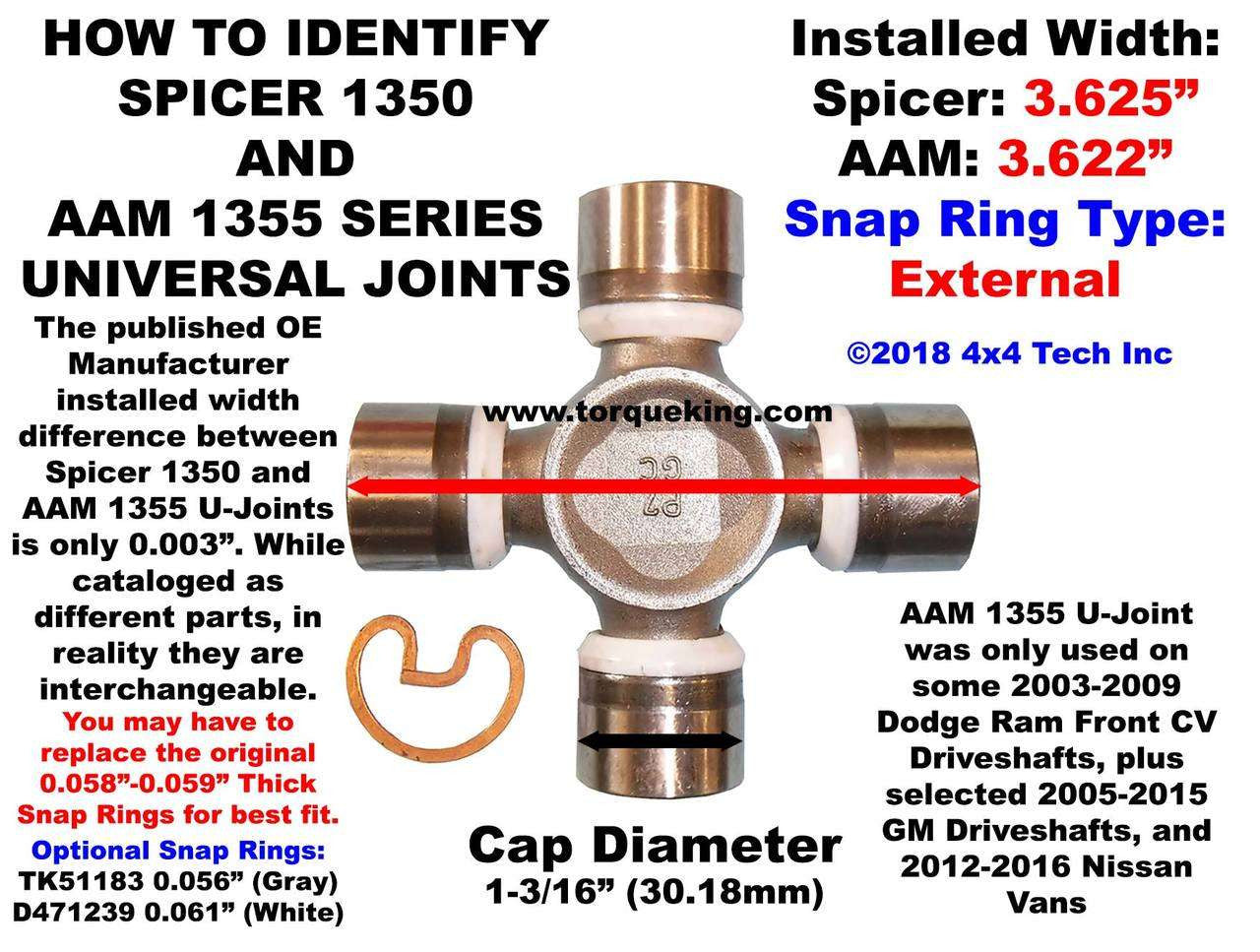
The 1350 has been in production since 1950 and has been used on 4x4s since 1960. The AAM 1355 first appeared in 2003 Ram front CV driveshafts. The published OE dimensions differ by only 0.003" — the manufacturing tolerances of the yokes actually overlap, and the two series are essentially interchangeable (adjusting snap ring thickness may be needed for best fit).
Specs:
- Cap diameter: 1-3/16"
- Overall installed width: 1350 = 3.625" / 1355 = 3.622"
- Retention: External snap rings; strap/bolts preferred at end yokes (U-bolts tend to distort 1350 caps)
From 1987 onward, strap and bolts became the standard for end yoke attachment. The main reason: U-bolts distort the caps, reducing service life. If you're rebuilding an older shaft that had U-bolts, consider switching to strap/bolts if the yoke allows it.

Spicer 1410 Series / AAM 1415 Series
The 1410 has been used since the 1950s across most domestic truck makes. The AAM 1415 first appeared in 2003 Dodge Ram 2500 and 3500 rear driveshafts. Some 2007+ GM models also use AAM 1415.
These are NOT interchangeable. The overall installed width differs by 0.010". A 1410 u-joint in a 1415 yoke will be very tight — the increased friction shortens part life. A 1415 in a 1410 yoke will be loose and can affect driveshaft balance.
Specs:
- Cap diameter: 1-3/16"
- Overall installed width: 1410 = 4.188" / 1415 = 4.178"
Warning: Aftermarket u-joint catalogs are highly unreliable in their listings of 1410 and 1415 series u-joints. If you're not sure which you have, contact us — we stock conversion snap rings that can compensate for the width difference when needed..


Hot-Forged vs. Cold-Forged Crosses
This applies to all series. Traditional hot-forged crosses are cheaper to produce but have a lower Rockwell hardness. Cold-forged crosses are harder and more expensive. Today, greaseable u-joints typically have hot-forged crosses. Lubed-for-life u-joints usually have cold-forged crosses.
For older or lower-power applications, either design works fine. For anything with a diesel or high-torque gas engine, use premium u-joints with cold-forged crosses. That's what we put in all the driveshafts we build.
Quick Reference: U-Joint Series Specs
| Series | Cap Diameter | Installed Width | Notes |
|---|---|---|---|
| 1310 | 1-1/16" | 3-7/32" | Light duty, in production since 1940 |
| 1330 | 1-1/16" | 3-5/8" | Same cap as 1310, wider |
| 1330F | 1-1/16" / 1-1/8" | 3-5/8" | Ford only, mixed cap sizes |
| 1310×1330 | 1-1/16" | 3-7/32" / 3-5/8" | Unequal cross, Ford only |
| 1350 | 1-3/16" | 3.625" | Most common heavy-duty |
| AAM 1355 | 1-3/16" | 3.622" | Essentially interchangeable with 1350 |
| 1410 | 1-3/16" | 4.188" | Heavy-duty, NOT interchangeable with 1415 |
| AAM 1415 | 1-3/16" | 4.178" | NOT interchangeable with 1410 |
CV Driveshaft Identification
Front driveshafts on most 4x4 trucks use a Double-Cardan Constant Velocity (CV) joint at the transfer case end to handle the steep operating angle. Identifying the CV type is as important as identifying the u-joint series, because the CV components — centering ball, center yoke, mounting flange — are all specific to the design.
Spicer End Yoke Style CV Joint
First supplied to GM for 1967 K-Series 4x4s, the Spicer end yoke design was used across Dodge, Ford, GM, and Jeep front (and some rear) driveshafts from 1970 through 1999. The Jeep Wrangler TJ was one of the last applications.
The identifying feature is a half-round centering yoke that bolts to the transfer case output yoke with 4 bolts. The centering yoke cradles the outer u-joint and has a ball-and-socket joint that rides on a ball stud welded to the tube yoke.
These came in 1310, 1330, and 1350 series. Early production shafts had greaseable CV balls; later production switched to lubed-for-life.


1977–1993 Dodge Front CV Driveshaft
The 1975½ through 1993 Dodge front CV shaft used a Saginaw Double-Cardan CV joint — a different design from the Spicer end yoke type. The key identifiers:
- Round mounting flange — 5" OD, 4-bolt, with bolts that thread into the transfer case output flange. If your CV flange is half-round, you have an aftermarket Spicer-type replacement.
- Center yoke with squared-off ends — the Saginaw center yoke has a distinctive squared shape, unlike the round Spicer design.
- Internal C-clip u-joints — factory CV u-joints use plastic injection or C-clips for retention. If you see external snap rings, the shaft has been rebuilt or replaced.
The CV components stayed the same for the entire 18-year run, but the slip joint and front u-joint varied:
- Slip joint: Through Jan 1986 = 1-1/4"-16 spline with external seal. Jan 1986–Mar 1988 = mixed. Mar 1988+ = 1-9/32" fine spline with boot.
- Front u-joint: 1975–1992 = Detroit Universal 7260 series (1.078" cups). 1993 diesel = Detroit 7290 series (1-1/8" cups).


1994–2002 Dodge Ram Front CV Driveshaft
All 1994–2002 Ram 2500 and 3500 4x4s came with Spicer 1330 series front CV driveshafts. The CV joint components stayed the same across the entire run, but three different slip joints and three different front u-joints were used:
- 1994–1998: Fine spline slip yoke, 7290 series front u-joint (internal C-clips)
- 1999 (transition year): Mixed — some fine spline, some coarse spline; front u-joint uses external snap rings in slip yoke and C-clips at pinion yoke
- 2000–2002: Coarse spline slip yoke, external snap ring front u-joint
Important: Model year changeovers don't always match production dates exactly. A late 1998 may have 1999 parts. If your truck is anywhere near a changeover year, verify what you have before ordering.


2003–2013 Dodge Ram Front CV Driveshaft
Quick ID: Measure the cap diameter of any of the eight u-joint caps in the CV head. Most 2003 and some 2004 trucks with original shafts = 1-1/16" caps (1330 series). Everything else = 1-3/16" caps (1350 or 1355 series). All use external snap rings. All shafts are 2½" diameter.

CV types by year:
- Spicer 1330: 1-1/16" caps, 3.625" width. 2003–2004. Non-greaseable CV ball.
- AAM 1355: 1-3/16" caps, 3.622" width. 2004.5–2009. Greaseable CV ball.
- Spicer 1350: 1-3/16" caps, 3.625" width. 2007–2013. Greaseable CV ball.
- Spicer 1410: 1-3/16" caps, 4.187" width. 2013+. Greaseable CV ball.
The front u-joint also changed: most 2003–2005 shafts use AAM 1344 (1-1/8" cups, internal C-clips). Some 2006–2009 and all 2007+ shafts use 1350/1355 series (1-3/16" cups, external snap rings).
Two slip joint designs were used: Type 1 has a female spline slip yoke with the boot at the inboard end. Type 2 has a male spline yoke shaft with the boot near the u-joint. All 2010+ trucks use Type 2.

2013+ Ram Front CV Driveshaft
For 2013, Ram 2500 and 3500 4x4s may have different front driveshafts:
- 1350 series (serrated flanges): This is the 5-link suspension, non-disconnect AAM axle used from 2003–2012 on Ram 3500 and 2003–2013.5 on Ram 2500. The driveshaft flange and front axle flange are serrated.
- 1410 series (flat flanges): All 2013 Ram 3500 with the 12-bolt electric disconnect front axle and 3-link suspension, plus late production Ram 2500 with 14-bolt non-disconnect axle. Flanges are flat-faced.
Quick visual check: Serrated flanges = 1350 shaft. Flat flanges = 1410 shaft. All 2014+ Ram 2500 and 3500 4x4s use 1410 series.


Still Not Sure?
Measure the cap diameter and overall installed width. If you can, note the retention method (external snap rings, internal C-clips, U-bolts, or strap/bolts). Take photos of the u-joint, the yoke, and the CV head if applicable.
Send us the photos and measurements. U-joint and driveshaft identification is one of the most common calls we get — especially for Dodge trucks where the parts changed multiple times within a single generation.
Call (866) 251-6762 or email sales@torqueking.com.
Tech Pages
Detailed identification pages with specs, photos, and year-by-year breakdowns:
- Chevy & GMC Driveshaft ID
- Dodge & Ram Driveshaft ID
- Ford Driveshaft ID
- IHC 4x4 Truck Parts
- Jeep Driveshaft ID
- U-Joint ID Help


Leave a comment
This site is protected by hCaptcha and the hCaptcha Privacy Policy and Terms of Service apply.